
Is every account titled to the trust the documents name?
Find out in five business days, from a CFO to five family offices for eighteen years. $3,500. If every account is titled as the documents name it, and every entity is in the books and has its latest return, you get every dollar back.
Read-only, in your own systems and your own files. I keep no copy of your documents; the finding is the only document that leaves. The call and the finding can be in Spanish.
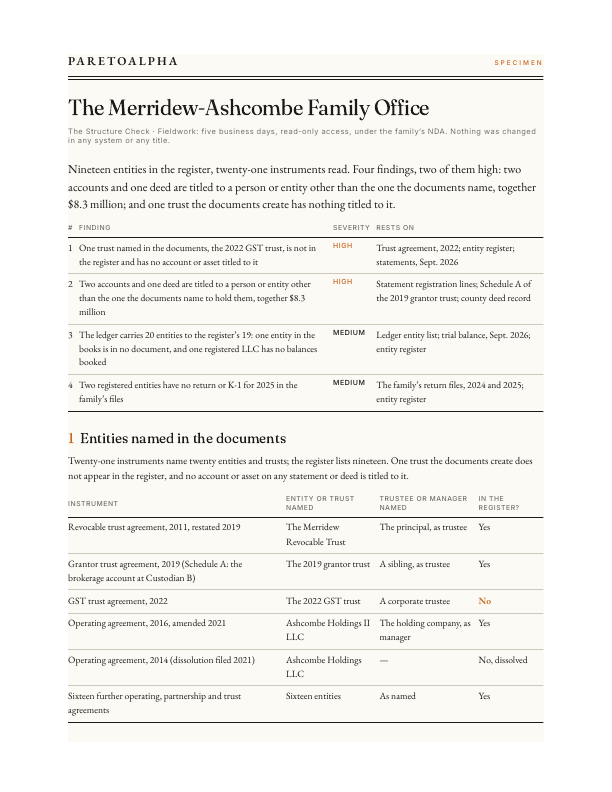
Four columns beside every entity, each from a document.
1: Entities named in the documents
Every trust agreement, operating agreement and partnership agreement, with its schedules, and the entity register: each entity's name, its trustee or manager, and what the documents name it to hold.A family office runs a median of 37 legal entities and files 43 tax returns a year. Family Office Exchange, Emerging Trends Among UHNW Families, 2024 (n = 151)
2: Accounts titled as the documents say
The registration line of every account on one month of statements, and the title line of every deed and certificate in the file, read against the entity the documents name. A schedule that names an asset is a sentence; the registration line is the fact.In one county's trust cases over seven years, 26% concerned property never moved into the trust; in 79% of those, nothing had been retitled at all. Horton, Ryan and Weisbord, The Trust Transfer Problem, 104 N.C. L. Rev. (2026)
3: Entities in the books
The ledger's entity list and each entity's balances, read against the register: every entity in the books, and every booked balance to an entity the documents name.More than half of family offices run ten or more trusts; a third manage 50 or more bank accounts. Bank of America, Family Office Study, 2025
4: A return for every entity
For each entity, its latest return or K-1 in the family's own files, read against the register: every entity accounted for, and every return to an entity that exists.76% of family offices outsource tax; about half look at the estate plan each year. Bank of America, Family Office Study, 2025 · Campden Wealth and AlTi Tiedemann, Operational Excellence Report, 2025
The The Controls Check reads who can move the money and which accounts no report shows. This check reads what the money sits in. The two are the Record’s Payments and Structure pages; either can be week one of the CFO Seat.
The titling finding first. The rest by day five.
- 01Day 1
Access
Your office gives read access to the instruments and their schedules, the entity register, one month of statements, the deeds and certificates in the file, the ledger's entity list and the family's copies of its latest returns. The five business days start when the access in the letter is given.
- 02Days 2 to 4
The sixteen readings
The titling finding comes within 48 hours of read access to the instruments and one month of statements, to the principal and the CFO together.
- 03Day 4
The draft
To the principal and the CFO together. The CFO has one business day to correct facts, in a reply attached to the finding.
- 04Day 5
The finding
To both, every difference beside its document, and an hour together on it. To the attorney or CPA who ordered the check the same day, if the letter says so.
The fraud protocol. If something looks like fraud, I stop the work and tell the principal in writing the same day. If money appears to be in transit, I tell the principal at once, so the bank can be called. What happens next is the family's decision. If the principal appears to be involved, I stop the work, return the fee in full, and step away. Nothing here limits a disclosure the law requires.
A finished one, on a fictitious family office.
Nineteen entities, twenty-one instruments. One trust the documents create with nothing titled to it. Two accounts and one deed, $8.3 million, titled to someone other than the entity the documents name. Each beside the instrument, the statement or the deed it rests on. Every name and figure in it is invented; the method and the form are the real engagement’s.
What a family can check.
ParetoAlpha does not discuss the families it works for, and will not confirm one. What a family can check before signing: the specimen, which is the real method and form on a fictitious office; the insurance certificate; the engagement letter and the NDA; a call before anything is signed; and the refund, which puts the fee at ParetoAlpha's risk.
Each check is measured: its hours, its entities, its exceptions, whether it was delivered by day five, and whether it was refunded. Who does it: J.R. Barbieri.
The fee, $3,500, returned on two conditions. If the statements show every account titled as the documents name it, and the ledger and the family's own files show every entity booked and with its latest return, you get every dollar back. If the finding is not delivered in five business days, the same, unless I have stopped the work under the fraud protocol on this page.
- The fee is invoiced and paid by wire before day one.
- “Titled as the documents name it” means the registration line on the account's statement, or the title line of the deed or certificate, names the entity or trust that the instrument or its schedule names to hold it. “In the books” means the entity appears in the ledger with its balances. “Its latest return” means a return or K-1 for the most recent closed year is in the family's own files.
- The five business days, and the promise, run from the day you give the read access listed in the letter: the trust and entity instruments and their schedules, the entity register, one month of bank and custodian statements, the deeds and certificates in the file, the ledger's entity list and trial balance, and the family's copies of its latest returns and K-1s.
- A refund is returned to the account the fee came from within ten business days of the finding, or of day five if the finding is late.
It prepares no tax return, drafts or amends no document, gives no tax, legal or investment advice, audits no financial statement and changes nothing in any system or any title.
Before anything is signed.
- I am not a CPA and not an attorney. This is not an audit, an attest engagement or legal advice. The check reads the documents; it does not interpret them, draft them or give advice on them.
- Under the letter, ParetoAlpha's liability is limited to the fee paid.
- ParetoAlpha holds no SOC report or ISO certificate. I complete your security questionnaire instead.
- Your office creates the read-only access to statements, instruments and the ledger, logs its use and revokes it on day five.
- I keep no copy of your documents. My copy of the finding is kept for four years under the NDA, then destroyed.
- Insured: professional liability, $2 million per claim and $2 million in the aggregate; cyber liability, $1 million. The certificate comes with the engagement letter.
- The engagement letter and the NDA come before any access. After the five days, nothing follows unless you ask. The signed engagement letter governs. Read the letter and the NDA.
Request the Structure Check.
A call with me comes before anything is signed. Nothing from your files is asked for before the engagement letter and the NDA.
For the attorney or CPA who orders it for a family. An attorney or CPA may order the check for a family. The finding goes to the principal and the CFO; the professional who ordered it receives the same finding on the same day if the family agrees in the letter, and otherwise learns only that the check is done. ParetoAlpha pays no referral fee and takes none. I manage no money and draft no document. The finding goes to the family, and to the attorney or CPA who ordered the check only if the family agrees to it in the letter. Send it to a colleague.